
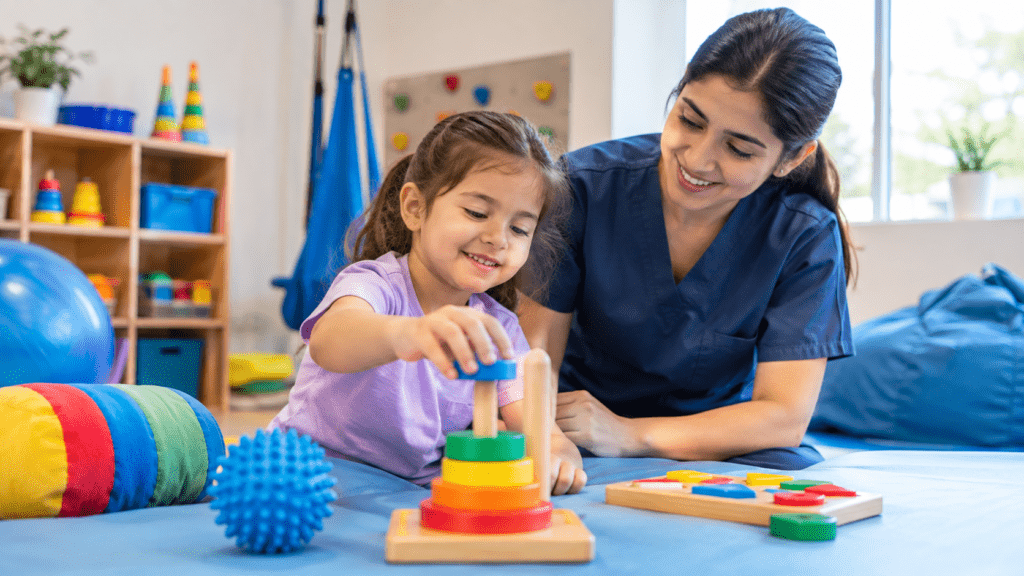
Is your child struggling with sensory skills or daily tasks? Discover how Occupational Therapy can build confidence, coordination, and independence.
Every child develops at their own pace. While some children quickly learn to dress themselves, hold a pencil, use utensils, or join classroom activities, others may find these everyday tasks surprisingly difficult.
That is where Occupational Therapy can make a meaningful difference. Through play, movement, and practical activities, therapists help children build skills they need to participate more comfortably at home, school, and in social settings.
What Is Occupational Therapy for Children?
Pediatric Occupational Therapy focuses on helping children develop the skills needed for everyday activities.
A therapist first looks at how a child moves, plays, communicates, learns, responds to sensory information, and manages daily routines. They then identify areas where the child may need additional support.
Every child is different, so therapy isn’t one-size-fits-all. Therapists tailor activities and goals to the child’s age, abilities, challenges, and everyday needs.
Understanding Sensory Skills in Children
Imagine hearing a loud noise and immediately covering your ears. Now imagine that ordinary classroom sounds feel overwhelming throughout the day. This is one example of how sensory processing can affect a child’s daily experience.
Sensory processing refers to how the brain receives and responds to information from the senses, including touch, sound, sight, movement, smell, and body position.
Some children may dislike certain textures, become distressed by loud sounds, avoid movement, or constantly seek activities such as jumping and spinning.
These responses can sometimes make dressing, eating, playing, learning, or participating in school activities more challenging.
How Occupational Therapy Supports Sensory Development
Therapists can use structured play and sensory-based activities to help children respond to sensory information more effectively.
Activities may involve movement, balance, touch, coordination, and body awareness. The therapist chooses activities according to the child’s needs rather than simply giving them more sensory stimulation.
Over time, these activities can help children participate more comfortably in routines at home and school.
The goal is practical: helping the child feel more prepared to learn, play, interact, and complete everyday activities.
Building Fine and Gross Motor Skills
Motor skills play a major role in childhood development.
Fine motor skills involve smaller movements, such as:
- Holding a pencil
- Drawing and writing
- Using scissors
- Buttoning clothes
- Using a spoon or fork
Gross motor skills involve larger body movements, including:
- Running
- Jumping
- Climbing
- Balancing
- Coordinating movements
Therapy may use games, crafts, obstacle courses, puzzles, and other engaging activities to strengthen these skills. For a child, it can feel like play rather than practice.
Improving Everyday Skills and Independence
Small everyday tasks can be big milestones for children.
Occupational Therapy can support skills involved in dressing, grooming, eating, handwriting, school routines, and other age-appropriate activities.
For example, a child who struggles to hold a spoon may work on hand strength and coordination. Another child may practice fastening buttons or managing a school bag.
These practical improvements can help children become more independent and confident in their daily lives.
Occupational Therapy for Children With Developmental Challenges
Children with different developmental needs may benefit from individualized support.
Occupational Therapy may be included as part of a broader care plan for children experiencing:
- Autism
- ADHD
- Developmental delays
- Sensory processing difficulties
- Learning challenges
- Coordination difficulties
The focus remains on the child’s specific abilities and challenges. Rather than trying to make every child perform in the same way, therapy works toward meaningful functional goals.
What Happens During an Occupational Therapy Session?
A child’s first session may include an assessment of motor skills, sensory responses, coordination, attention, and everyday abilities.
The therapist then works with the family to identify practical goals. These might include improving handwriting, managing clothing independently, participating in classroom activities, or becoming more comfortable with certain sensory experiences.
Sessions often include play-based and functional activities designed around those goals.
Progress is monitored over time, and therapists may also give parents simple activities or strategies to use at home.
When Should Parents Consider Occupational Therapy?
Parents may want to seek professional guidance if a child consistently struggles with everyday activities.
Some signs to watch for include:
- Difficulty completing age-appropriate daily tasks
- Frequent problems with balance or coordination
- Strong reactions to sounds, textures, or movement
- Difficulty with handwriting or classroom activities
- Trouble developing independence with self-care
- Avoiding activities that other children of the same age enjoy
One occasional difficulty does not necessarily mean a child needs therapy. Persistent challenges that interfere with daily life are worth discussing with a qualified professional.
How Parents Can Support Skills at Home
Parents can support development through simple everyday opportunities.
Encourage your child to participate in age-appropriate tasks such as dressing, tidying toys, eating independently, or helping with simple household activities.
Play can also become a learning opportunity. Drawing, building with blocks, playing catch, completing puzzles, and doing craft activities can naturally encourage coordination and motor skills.
Predictable routines can make daily activities easier to manage. Most importantly, follow the strategies recommended by your child’s therapist and celebrate gradual progress.
Sometimes putting on one shoe independently is a bigger victory than it looks!
Frequently Asked Questions
What does Occupational Therapy do for children?
It helps children develop practical skills related to movement, coordination, sensory processing, self-care, learning, and participation in everyday activities.
At what age can a child start Occupational Therapy?
Children can receive support at different ages depending on their developmental needs. A professional assessment can help determine whether therapy is appropriate.
Can Occupational Therapy help children with sensory issues?
Yes. Therapists can use individualized sensory-based strategies and activities to help children participate more comfortably in daily routines.
How does Occupational Therapy help children with autism?
It may support areas such as sensory processing, fine motor skills, self-care, coordination, and participation in everyday activities, depending on the child’s individual needs.
How long does Occupational Therapy take to show results?
Progress varies from child to child. It depends on the child’s goals, challenges, participation, and consistency of therapy. Regular assessment helps track development over time.
Helping Children Feel More Confident in Everyday Life
Occupational Therapy is about much more than practicing individual skills. It helps children take part in the everyday moments that matter, from getting dressed in the morning to participating in classroom activities and playing with friends.
If your child consistently struggles with sensory responses, coordination, motor skills, self-care, or everyday activities, a professional assessment can help you understand what support may be appropriate.
For families looking for Occupational Therapy for Children in Dubai, Openminds Center provides individualized support focused on each child’s developmental needs and everyday goals.