
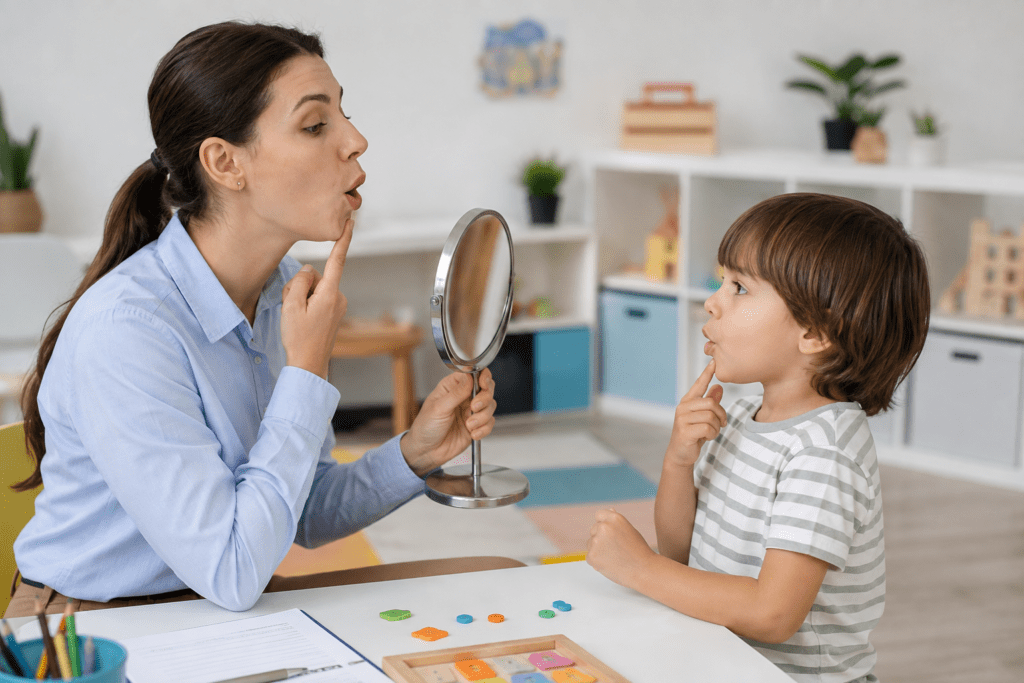
Discover how speech therapy in Dubai helps children improve speech, language, communication skills, and confidence with personalized pediatric support.
Every child has a unique way of learning, growing, and communicating. Some children begin speaking early and quickly develop a wide vocabulary, while others take more time to pronounce sounds, form sentences, understand language, or express their thoughts.
But what happens when a child continues to struggle with communication?
Difficulty speaking clearly or expressing needs can sometimes affect a child’s interactions at home, participation in school, friendships, and overall confidence. This is where professional speech therapy in Dubai can provide valuable support.
Speech therapy for children focuses on much more than correcting pronunciation. It can help children develop clearer speech, stronger language skills, better communication abilities, and greater confidence in expressing themselves.
For parents concerned about their child’s speech or language development, understanding how pediatric speech therapy works and when to seek professional guidance can be an important first step.
What Is Speech Therapy for Children?
Speech therapy is a specialized service that helps children develop and improve speech, language, communication, and related skills.
A qualified speech and language therapist evaluates how a child communicates and identifies areas where additional support may be helpful. Depending on the child’s individual needs, therapy may focus on pronunciation, vocabulary, sentence formation, understanding language, fluency, social communication, or other communication skills.
Children’s speech therapy may help with:
- Pronouncing speech sounds more clearly
- Expanding vocabulary
- Forming words and sentences
- Understanding spoken language
- Improving conversation skills
- Developing listening abilities
- Supporting fluency
- Strengthening social communication
- Expressing thoughts and emotions
- Building communication confidence
The goal is not to make every child communicate in exactly the same way. Instead, therapy is designed around the child’s individual strengths, needs, age, and communication goals.
When Should a Child See a Speech Therapist in Dubai?
One of the most common questions parents ask is, “Does my child need speech therapy?”
Children develop at different rates, so occasional differences in communication do not automatically indicate a problem. However, persistent difficulties or noticeable concerns may be worth discussing with a qualified professional.
Parents may consider consulting a speech therapist for children in Dubai if their child:
- Is difficult for family members or others to understand
- Uses fewer words than expected for their stage of development
- Has difficulty putting words together
- Struggles to understand simple instructions
- Has difficulty pronouncing particular sounds
- Frequently repeats sounds, words, or phrases
- Has noticeable stuttering or fluency difficulties
- Becomes frustrated when trying to communicate
- Avoids speaking or joining conversations
- Has difficulty interacting with other children
- Struggles to express needs, thoughts, or feelings
- Shows a regression in previously developed communication skills
Parents do not necessarily need to wait until a communication difficulty becomes severe before seeking advice. A professional assessment can help determine whether a child is developing appropriately or could benefit from additional support.
How Speech Therapy Helps Children Speak More Clearly
Clear speech can make it easier for children to participate in conversations, classroom activities, family interactions, and social situations.
During therapy, children may participate in age-appropriate activities that help them recognize, practice, and produce speech sounds more accurately. Depending on the child’s needs, sessions may include games, pictures, storytelling, repetition, conversation exercises, and interactive activities.
With consistent practice and individualized guidance, speech therapy may help children:
- Improve pronunciation
- Produce challenging sounds more accurately
- Speak more clearly
- Become easier for others to understand
- Use words appropriately
- Build longer and more meaningful sentences
- Express their thoughts
- Participate more confidently in conversations
Every child responds differently to therapy. Progress may depend on the child’s communication needs, age, consistency of practice, and individual development.
Speech Delay and Language Delay: What Is the Difference?
Speech delay and language delay are often confused, but they involve different aspects of communication.
A speech delay generally relates to how a child produces sounds and speaks. For example, a child may understand what they want to say but have difficulty pronouncing particular sounds clearly.
A language delay, on the other hand, may involve difficulties understanding or using words and sentences. A child may struggle to learn new vocabulary, follow instructions, answer questions, combine words, or communicate ideas.
Some children can experience both speech and language difficulties.
A professional speech and language assessment can help identify which areas require attention and whether speech therapy may be appropriate.
How Pediatric Speech Therapy Improves Communication Skills
Communication involves much more than saying words correctly.
Children need to learn how to listen, understand information, respond appropriately, ask questions, take turns, describe experiences, and communicate their feelings.
Pediatric speech therapy in Dubai can support these skills through activities designed around the child’s age and abilities.
Therapy may help children learn to:
- Follow and understand instructions
- Answer questions
- Learn and use new vocabulary
- Describe objects and activities
- Build sentences
- Tell simple stories
- Take turns during conversations
- Express their needs and emotions
- Participate in social interactions
- Understand aspects of social communication
Developing these skills can make everyday communication easier and more meaningful.
Can Speech Therapy Help Build a Child’s Confidence?
Communication and confidence can be closely connected.
A child who frequently needs to repeat themselves or feels misunderstood may become hesitant to speak. Some children may avoid answering questions, joining group activities, or interacting with other children because communicating feels difficult.
Speech therapy can create a supportive environment where children can practice communication skills without feeling pressured to be perfect.
As children experience small successes, their confidence may gradually grow. Saying a difficult sound correctly, answering a question, using a new word, or independently communicating a need can all be positive steps.
The aim is to help children feel more comfortable using their communication skills in everyday situations.
What Happens During a Speech Therapy Assessment?
A speech and language assessment is tailored to the individual child.
The therapist may evaluate several areas, including:
- Speech sound production
- Vocabulary
- Understanding of language
- Sentence formation
- Listening skills
- Fluency
- Voice
- Social communication
- Overall communication abilities
Parents may also be asked about the child’s developmental history, communication at home, and specific concerns they have noticed.
The assessment helps the therapist understand the child’s strengths and identify areas that may require additional support.
Based on the findings, the therapist can recommend appropriate therapy goals and strategies.
What Happens During Children’s Speech Therapy?
Speech therapy sessions are adapted according to a child’s age, abilities, interests, and communication goals.
For younger children, therapy may use play-based activities, toys, picture cards, songs, storytelling, and interactive games. These activities can make communication practice engaging and comfortable.
Older children may work on pronunciation, vocabulary, sentence construction, conversation skills, fluency, or other communication goals using age-appropriate activities.
Parents may also receive practical strategies and exercises that can be incorporated into daily routines.
This is important because communication development does not happen only inside a therapy room. Everyday conversations at home can provide valuable opportunities for children to practice what they are learning.
Why Early Speech and Language Support Can Be Helpful
Early childhood is an important period for communication development. When persistent speech or language difficulties are identified, professional guidance can help parents understand their child’s needs and available support.
Early intervention may help children strengthen communication skills before difficulties significantly interfere with learning, social participation, or everyday interactions.
However, every child develops differently. Parents should avoid comparing their child’s progress too closely with another child’s development.
Instead, concerns should be considered in the context of the child’s overall communication abilities, development, and individual circumstances.
Simple Ways Parents Can Support Speech Development at Home
Parents can play an important role in encouraging communication outside therapy sessions.
Talk During Everyday Activities
Talk to your child while cooking, shopping, getting dressed, bathing, or travelling. Describing everyday activities naturally introduces new words and concepts.
Read Together Every Day
Picture books can encourage children to listen, learn vocabulary, answer questions, and describe what they see.
Give Your Child Time to Respond
After asking a question, allow your child enough time to think and respond. Avoid immediately answering on their behalf.
Expand What Your Child Says
If your child says, “car,” you might respond, “Yes, that is a red car.” This provides a natural example of how words can be expanded into longer phrases.
Encourage Conversation
Talk about your child’s day, favourite activities, toys, stories, and experiences. Encourage them to describe what happened and how they feel.
Celebrate Communication Efforts
Positive encouragement can make communication more enjoyable. Focus on the child’s effort to communicate rather than correcting every mistake.
How to Choose Speech Therapy in Dubai for Your Child
Finding the right speech therapy service involves more than choosing a convenient location.
Parents searching for speech therapy in Dubai may want to consider:
- The therapist’s qualifications and experience
- Experience working with children
- The assessment process
- Individualized therapy planning
- Parent involvement
- The therapy environment
- Communication between the therapist and family
- Progress monitoring and follow up
A child focused approach should recognize that every child has different strengths, challenges, interests, and learning needs.
Frequently Asked Questions About Speech Therapy in Dubai
At what age can a child start speech therapy?
There is no single age at which every child should begin speech therapy. If parents have concerns about speech, language, or communication development, discussing those concerns with a qualified professional can help determine whether an assessment is appropriate.
Does every child who talks late need speech therapy?
Not necessarily. Some children who begin talking later may catch up, while others may benefit from additional support. A professional assessment can help identify the child’s specific communication needs.
How long does children’s speech therapy take?
The duration of therapy varies from child to child. It can depend on the type and severity of the communication difficulty, the child’s age, therapy goals, attendance, home practice, and progress.
Can parents participate in speech therapy?
Yes. Parent involvement can be an important part of supporting communication development. Therapists may provide parents with practical strategies and activities to use at home.
Can speech therapy improve pronunciation?
Speech therapy can help children work on pronunciation and speech sound production when these are areas of difficulty. The appropriate approach depends on the child’s individual needs.
Is speech therapy only for children who cannot speak?
No. Speech therapy can support children with many different communication needs, including pronunciation difficulties, language delays, fluency concerns, social communication difficulties, and other speech and language challenges.
Help Your Child Communicate With Greater Confidence
A child’s ability to communicate can influence much more than their speech. Communication skills can affect learning, friendships, family interactions, independence, participation, and confidence.
If your child is struggling to pronounce words clearly, understand language, express thoughts, build sentences, or participate in conversations, professional guidance may help you better understand their communication needs.
For parents searching for speech therapy in Dubai, an individualized assessment can be a valuable starting point. With appropriate guidance, consistent practice, family involvement, and encouragement, children can work toward stronger communication skills and greater confidence.
Every child has a unique voice. Supporting that voice early can help create more opportunities for children to express themselves, connect with others, and participate confidently in everyday life.