
Every child wants to be understood. For children on the autism spectrum, communication can feel like trying to tune into a radio station that keeps fading in and out. That’s where Speech Therapy for Autism steps in—helping children find their voice, express their thoughts, and connect with the world around them.
At Openminds Center, we see communication not just as words, but as confidence, connection, and self-expression.
Understanding Autism Spectrum Disorder (ASD)
Autism Spectrum Disorder (ASD) affects how a child communicates, interacts socially, and processes information. Each child with autism is unique—some may speak fluently, while others may struggle to use words at all.
What’s common, though, is that communication doesn’t always come easily. And when a child can’t express needs or emotions, frustration builds quickly—for both the child and the family.
Common Speech & Communication Challenges in Autism
Children with autism may face a range of communication hurdles, such as:
- Delayed speech development, where words come later than expected
- Limited vocabulary or difficulty forming meaningful sentences
- Non-verbal challenges, including reduced eye contact or gestures
- Echolalia, where words or phrases are repeated without clear meaning
- Difficulty understanding social cues, jokes, or back-and-forth conversations
These challenges can affect daily life, school performance, and social relationships.
What Is Speech Therapy for Autism?
Speech therapy focuses on improving how a child understands language (receptive skills) and how they express themselves (expressive skills).
A trained speech-language pathologist (SLP) works closely with the child to build communication skills step by step. There’s no one-size-fits-all plan here—therapy is always customized based on the child’s age, strengths, challenges, and goals.
Key Goals of Speech Therapy for Children with Autism
Speech therapy aims to help children:
- Use functional language in daily life
- Improve speech clarity and pronunciation
- Develop non-verbal communication like gestures and facial expressions
- Engage in two-way conversations
- Express emotions, needs, and ideas with confidence
In short, it’s about helping children feel understood—and empowered.
Techniques Used in Speech Therapy for Autism
Therapy sessions are anything but boring. In fact, many children see them as playtime (a win-win!).
Common approaches include:
- Play-based, child-led activities to keep learning natural and fun
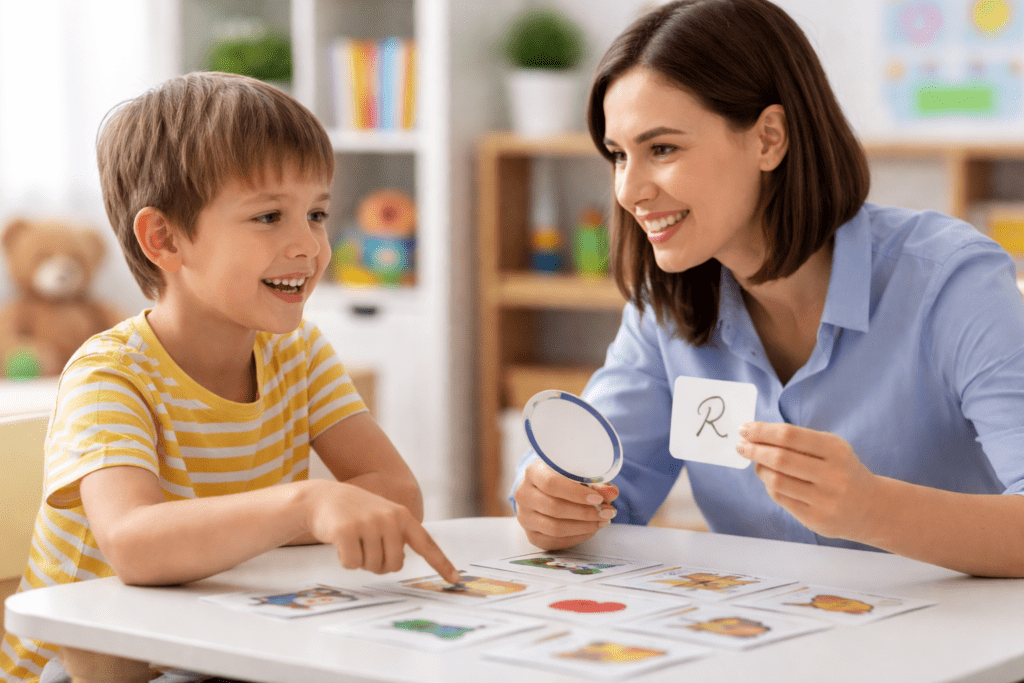
- Visual supports like picture cards and schedules
- AAC tools (Augmentative and Alternative Communication) for non-verbal children
- Social stories and role-playing to practice real-life situations
- Repetition, modeling, and positive reinforcement
Think less classroom, more “learning through everyday moments.”
How Speech Therapy Improves Language Skills
Over time, speech therapy helps children:
- Build vocabulary and form clearer sentences
- Understand instructions, questions, and everyday conversations
- Strengthen both expressive (speaking) and receptive (understanding) language
- Communicate effectively, whether verbally or non-verbally
Even little progress—like pointing, signing, or using pictures—can be life-changing.
Building Confidence Through Communication
When children can express themselves, something magical happens.
- Frustration reduces
- Social interaction becomes easier
- Confidence grows naturally
- Children feel heard, understood, and valued
It’s like finally having the right words during an awkward moment—we’ve all been there.
When Should a Child Start Speech Therapy?
Early support makes a big difference. If a child shows signs like delayed speech, limited response to name, or difficulty expressing needs, it’s worth seeking help early.
That said, older children and teens can also benefit greatly. Progress doesn’t expire with age.
The Role of Parents in Speech Therapy Progress
Parents are a child’s first and most important communication partners.
Simple actions—like repeating words, using visuals at home, and following therapy strategies—can reinforce progress. Regular communication between parents and therapists keeps goals aligned and growth consistent.
What to Expect During Speech Therapy Sessions
Therapy usually starts with an assessment to understand the child’s needs. From there, clear goals are set.
Sessions are structured yet flexible, and progress is tracked through small but meaningful milestones. Every step forward counts.
Speech Therapy for Autism in UAE / Dubai
Dubai offers access to skilled speech therapists and multidisciplinary care. At Openminds Center, children benefit from culturally sensitive, multilingual therapy supported by occupational therapists, psychologists, and behavioral specialists.
Teamwork makes therapy more effective—and more holistic.
Choosing the Right Speech Therapy Center
Look for a center that offers:
- Experienced and qualified therapists
- Personalized treatment plans
- A warm, child-friendly environment
- Active parent involvement and regular progress updates
Feeling comfortable and supported matters—for both child and parent.
Frequently Asked Questions
Is speech therapy effective for non-verbal children with autism?
Yes. Therapy focuses on communication, not just speech, using tools like AAC.
How long does it take to see results?
Progress varies, but consistency often brings noticeable improvements over time.
Can speech therapy improve social skills?
Absolutely. Communication is the foundation of social interaction.
How often should sessions be scheduled?
This depends on the child’s needs, but regular sessions bring the best results.
Final Thoughts
Speech Therapy for Autism is about more than words—it’s about connection, confidence, and possibility.
If your child is struggling to communicate, early and professional support can open doors you didn’t even know were closed. At Openminds Center, we’re here to help every child find their voice—one word, one gesture, one breakthrough at a time.
Because every child deserves to be heard.